
How COGS Is Applied to Orders
1. Effective Date Logic
Each cost entry has an Effective Date.
-
When an order is placed, the system selects the most recent cost record whose effective date is on or before the order date.
-
This ensures historical accuracy—older orders keep their original cost even if prices change later.
Example
-
Cost effective Jan 2, 2026: $150
-
Order date: Jan 10, 2026
→ COGS used = $150 per unit
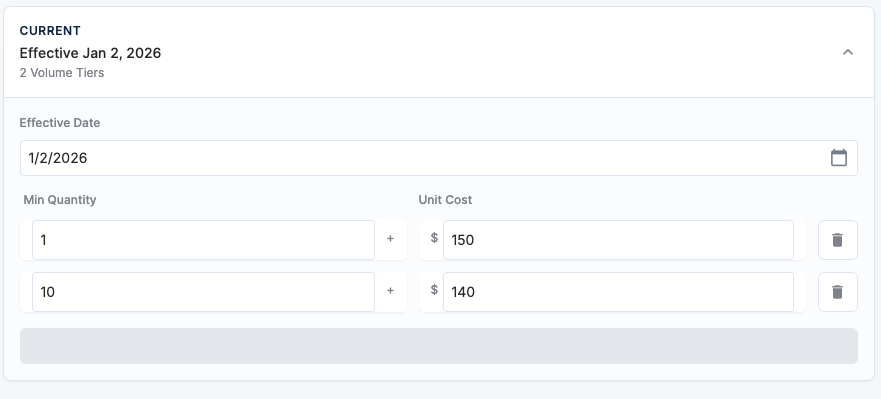
2. Quantity (Volume Tier) Logic
COGS can change based on quantity purchased in a single order.
Each tier includes:
-
Minimum Quantity
-
Unit Cost
The system:
-
Looks at the order line quantity
-
Applies the highest matching tier
Example
-
Order of 5 units → $150/unit
-
Order of 12 units → $140/unit
3. Line-Item COGS Calculation
For each order line:
Line COGS = Unit Cost × Quantity
Example
-
Unit cost: $150
-
Quantity: 2
→ Line COGS = $300
How COGS Affects Profit
Profit is calculated per order as:
Profit = Revenue − COGS − Shipping − Fees − Other Costs
So COGS is usually:
-
The largest single cost component
-
The first deduction from revenue
Example Order
-
Revenue: $400
-
COGS: $300
-
Shipping: $25
-
Fees: $15
Profit = 400 − 300 − 25 − 15 = $60
If COGS is incorrect or missing:
-
Profit appears inflated
-
Margin percentages become misleading
-
Scaling decisions are based on false data